For years, SEO, PR/AR, and content marketing were seen as separate disciplines. Then AI changed how people discover information. Today, your prospects move seamlessly between Google, Claude, industry publications, analyst reports, podcasts, and social media. As a result, traditional marketing silos no longer work. The good news? AI is helping level the playing field, creating new opportunities for smaller and less established brands to compete with much larger competitors.
The companies that build awareness, credibility, and trust today establish a consistent presence across multiple channels. Public relations, analyst relations, search engine optimization, answer engine optimization, and generative engine optimization are complementary disciplines within an integrated visibility strategy.
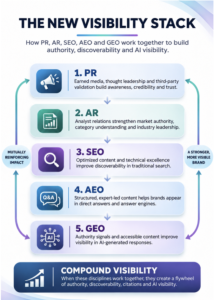
This is the new visibility stack. It creates momentum, building and reinforcing awareness, credibility and trust.
What Is the New Visibility Stack?
The New Visibility Stack brings together five complementary disciplines that reinforce one another rather than operating in a fixed sequence:
● PR establishes awareness, credibility and trust
● AR establishes authority and leadership
● SEO improves discoverability
● AEO (Answer Engine Optimization) helps brands to appear in answers
● GEO (Generative Engine Optimization) improves visibility within AI-generated responses
Organizations that integrate all five gain a significant advantage over competitors who treat them as separate marketing functions. This new game allows less established organizations to gain visibility faster than their competitors – even if the competitor is a goliath.
Layer One: PR Creates Awareness, Credibility and Trust
Public relations activities have traditionally focused on gaining media coverage, thought leadership, and brand awareness.
Those objectives remain important, but PR now plays a much larger role in digital discoverability.
When your company is quoted in respected publications, participates in industry discussions, or earns third-party coverage, it creates trust signals that extend far beyond brand awareness.
Those signals influence:
● Customers and prospective customers
● Journalists
● Industry analysts
● Search engines
● AI chatbots
A mention in a respected publication carries more weight than a claim made on a company website. This third-party industry influencer validation establishes expertise and credibility in a way that self-published content cannot.
For technology companies, PR is no longer just about generating headlines. It is about creating authority (credibility and trust) that can be recognized across the digital world.
Layer Two: AR Builds Authority and Market Leadership
Like PR, an effective analyst relations strategy now plays a greater role in digital discovery. AR goes beyond briefing analysts on products and company news. By building relationships with analysts, you can help them understand your company’s technology, market position and differentiation, shaping research that in turn informs buyer understanding.
Strong analyst relationships can help companies build market authority and leadership by:
● Increasing market credibility: ensuring analysts understand capabilities and competitive differentiation.
● Contributing to research: sharing relevant expertise, evidence and perspectives to analyst research and commentary.
● Supporting buyer evaluation: helping analysts develop an accurate picture of your company’s offering and where it fits in the industry.
● Strengthening visibility: contributing to analyst-published research, commentary or vendor references.
When analysts understand a company and its value, they can help to shape how the industry perceives it, providing another way for prospective customers and others to discover a company’s expertise and offerings. While most analyst reports sit behind paywalls, many analysts also write articles, newsletters and social posts that will cover trends, issues and companies.
Layer Three: SEO Creates Search Visibility
These activities alone aren’t enough. Your content still needs to be discoverable when prospects search for information. This is where SEO continues to play a critical role, in helping organizations appear when customers and prospects search for:
● Industry challenges
● Product categories
● Technical solutions
● Market trends
● Vendor evaluations
Strong SEO creates visibility in traditional search results while helping search engines understand your expertise and topical relevance. And, most importantly, PR, AR, and SEO are deeply connected.
Media coverage and analyst mentions often generate backlinks, branded searches, citations, and mentions that strengthen organic search performance. Likewise, high-quality content created for SEO can support PR efforts by providing valuable resources for journalists and analysts.
The strongest visibility programs treat PR, AR and SEO as complementary disciplines rather than separate marketing functions.
How SEO Intelligence Makes PR More Effective
Search and AI visibility research can identify emerging buyer questions, competitive content gaps, and influential sources. PR and analyst relations teams can use these insights to prioritize outreach and thought leadership. Earned coverage, in turn, can inform follow-up content and provide credible external references.
Layer Four: AEO Creates Answer Visibility
Buyers increasingly use AI-powered research alongside traditional search as they investigate technology options. According to Forrester’s Buyer’s Journey Survey, 2024, 89% of buyers reported that they were using genAI in at least one area of their purchasing process.
Rather than relying only on short keyword phrases, prospects also ask detailed questions to evaluate solutions against their challenges, such as:
● What are the leading companies in XXXX market?
● How can XXX technology solve my XXX challenge?
● What should I consider when evaluating XXXX technology providers?
● How do Technology A and B solve my XXX challenge and what are the differences between them?
● What vendors have expertise in solving XXX challenge?
● What are the latest trends and innovations in XXXX technology?
Answer Engine Optimization (AEO) helps make accurate, useful content easier for search and answer systems to interpret, extract, and present in response to questions. It overlaps with GEO but emphasizes clear and accessible answers. Effective AEO strategies include:
● Clear question-and-answer structures
● Well-organized content
● Expert insights
● Concise explanations
● Strong topical authority
The goal extends beyond ranking to being accurately represented, referenced, and cited when relevant. Clear answers, strong information architecture, original expertise, and credible supporting sources can help systems understand content. Relationships with journalists, analysts, and industry experts create further opportunities for independent perspectives and references, although inclusion in any given answer is not guaranteed.
The sources selected for an answer vary by platform, query, available material, and retrieval method. Credible, relevant third-party coverage can increase the opportunities for discovery and citation but does not determine answer selection on its own.
Layer Five: GEO Creates AI Visibility
The newest layer of the stack is Generative Engine Optimization, or GEO. AI-powered platforms such as Claude, ChatGPT, Gemini, and Perplexity are rapidly becoming research tools for your prospects and customers.
Rather than reviewing dozens of websites, they increasingly ask AI systems to summarize markets, compare vendors, explain technologies, and identify industry leaders. This creates a new visibility challenge for your company and products.
● Can AI systems find you?
● Can they understand what you do?
● Do they recognize your expertise?
● How is your brand represented relative to competitors?
● Will they mention your company when relevant questions are asked?
Generative Engine Optimization (GEO) focuses on improving how a brand, its expertise, and its content are represented and referenced in AI-generated research and recommendations. It shares many foundations with SEO and AEO, including accessible content, clear topic coverage, credible external references, and accurate brand information. Relevant sources include:
● Media coverage
● Expert interviews
● Analyst mentions
● Industry citations
● Thought leadership content
● Strong entity recognition
PR and AR can contribute valuable independent perspectives to GEO, alongside accessible first-party content, technical discoverability, and a clear content strategy. The impact of a piece of coverage depends partly on whether an AI platform can access and use that source.
Why These Five Disciplines Work Better Together
Many organizations still operate PR, AR, SEO, and content marketing as separate programs managed by different teams with different objectives. However, that approach is becoming increasingly ineffective.
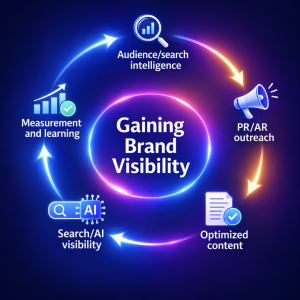
The organizations gaining visibility today coordinate earned coverage, research, content optimization, and measurement in a continuous cycle. Insights from each discipline can inform the others, creating opportunities for compounding visibility without assuming that one activity automatically causes the next.
What This Means for Your Company
A large proportion of the tech Buyer’s Journey today is conducted long before customers or prospects engage with sales teams. By the time a prospect reaches out, they may have already interacted with your brand through search results, industry publications, LinkedIn content, analyst commentary, and AI-generated answers.
You must be visible everywhere buyers seek information. As a result, a modern visibility strategy should include:
PR
● Executive thought leadership
● Media relations
● Industry speaking opportunities
AR
● Briefings on news
● Annual interviews
● Report participation
SEO
● Technical optimization
● Topic clusters
● Keyword strategy
● Content development
AEO
● Structured answers
● FAQ content
● Expert-driven resources
● Clear information architecture
GEO
● Entity building
● Citation development
● Authority expansion
● AI search monitoring
Organizations that align these disciplines will be better positioned to influence buyer research across every stage of the journey.
Measuring the New Visibility Stack
A coordinated program should measure both channel-level outcomes and combined business impact: relevant earned coverage and editorial links (PR); published analyst references (AR); nonbranded organic visibility, qualified traffic, and conversions (SEO); presence in search answer features and cited pages (AEO); and relevant AI brand mentions, citations, competitive visibility, and referral traffic (GEO). These measures guide what the team researches, pitches, publishes, and improves next.
Putting the New Visibility Stack to Work
Calysto and Haas Marketing Company bring complementary capabilities together. Calysto contributes messaging, public relations, analyst relations, and thought leadership expertise, while Haas Marketing provides SEO, AEO, GEO and more. Together, the firms can connect audience research, independent credibility, discoverable content, and measurement across the modern buyer journey.
That’s why our two companies have come together in a new partnership, combining our expertise to support technology companies with comprehensive integrated B2B marketing communications programs. Together, we can help them leverage the potential of the visibility stack for their own unique market and audiences.
Read more in the press release and contact us to discover how we can support your company.